
Global gold output is likely nearing its peak, with gold mining production gradually plateauing over the next two years, according to a new report from the World Gold Council.
Gold mining output to peak in 2027 with gradual plateau rather than sharp drop – World Gold Council
By Ernest Hoffman
Published:
Updated:

(Kitco News) – Global gold output is likely nearing its peak, with gold mining production gradually plateauing over the next two years, according to a new report from the World Gold Council.
“Global gold mining has been stable in recent years. Despite short-term impacts stemming from the pandemic, safety stoppages, and industrial action, mined gold production averaged a near-zero annual y/y change between 2018 and 2024,” wrote Senior Market Strategist John Reade and Head of Research (Asia Pacific, ex-India) Ray Jia in a new analysis published Wednesday. “And in 2024 mined gold production reached 3,645t, 4t higher y/y and the second highest annual total after the 2018 high of 3,658t.”
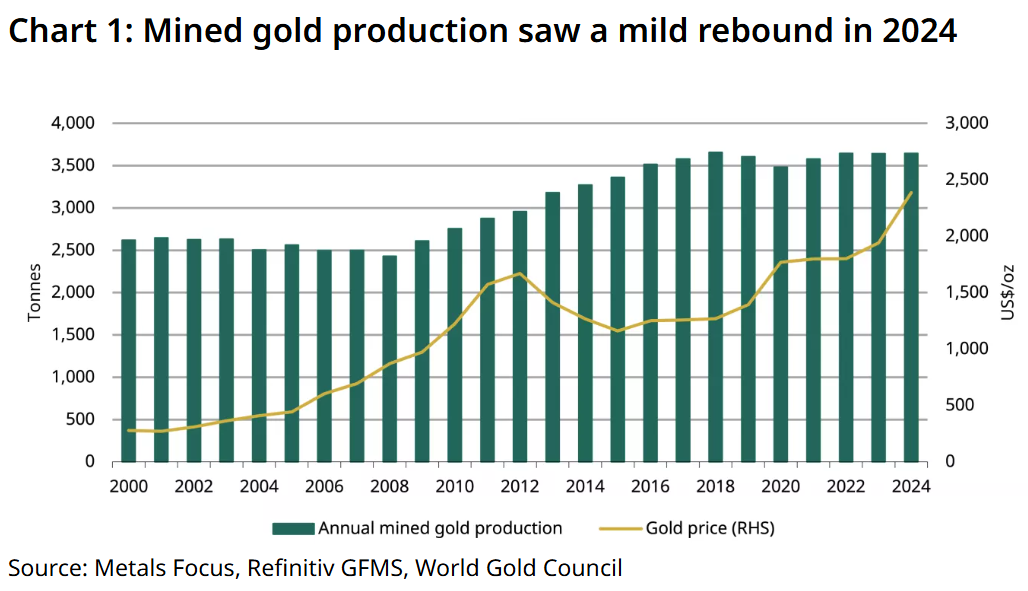
“During the first three quarters of 2025, gold production totalled 2,717t, a 16t y/y rise,” the authors noted. “Against the background of a surging gold price, we have seen only mild upticks in output, raising critical questions about whether the industry is nearing its limits – and what that means for future supply.”
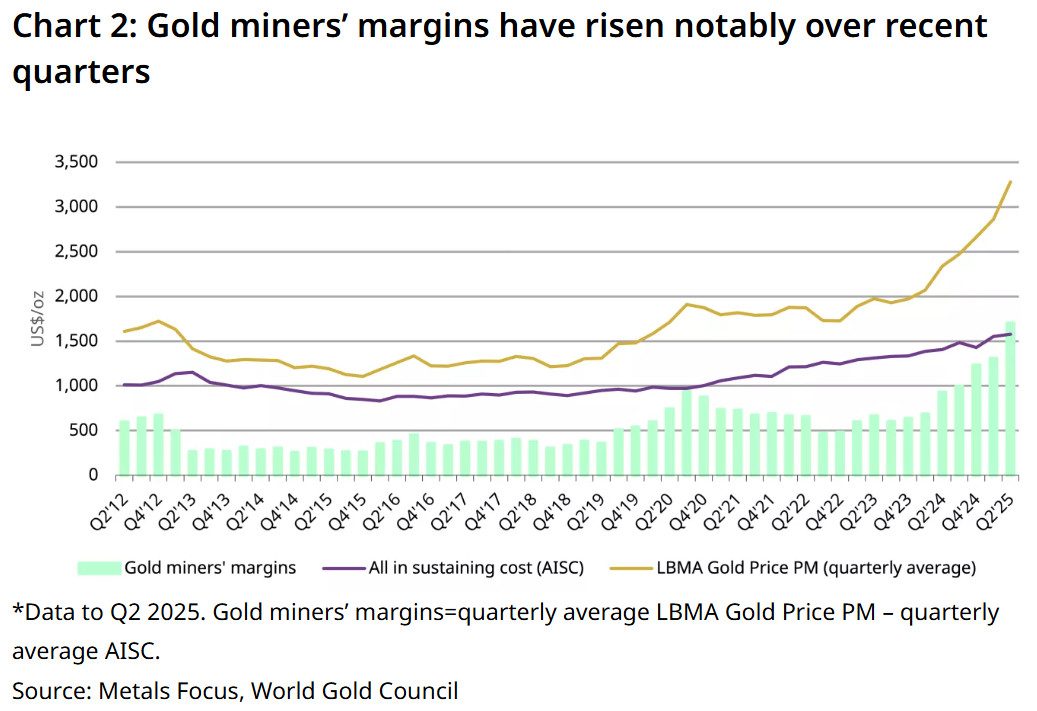
Based on Q1-Q3 data and trends, Reade and Jia believe 2025 set a new record high in mined gold production, supported by a number of key drivers, including rising margins, new projects, operational expansions, and rising output from artisanal and small-scale gold mining.
“While sanctions could slow development, additional contributions from new mines in regions like Russia may further boost total production,” they wrote. “That said, the suspension of a few operations has had a notable impact on global output during 2025 and could continue to limit growth.”
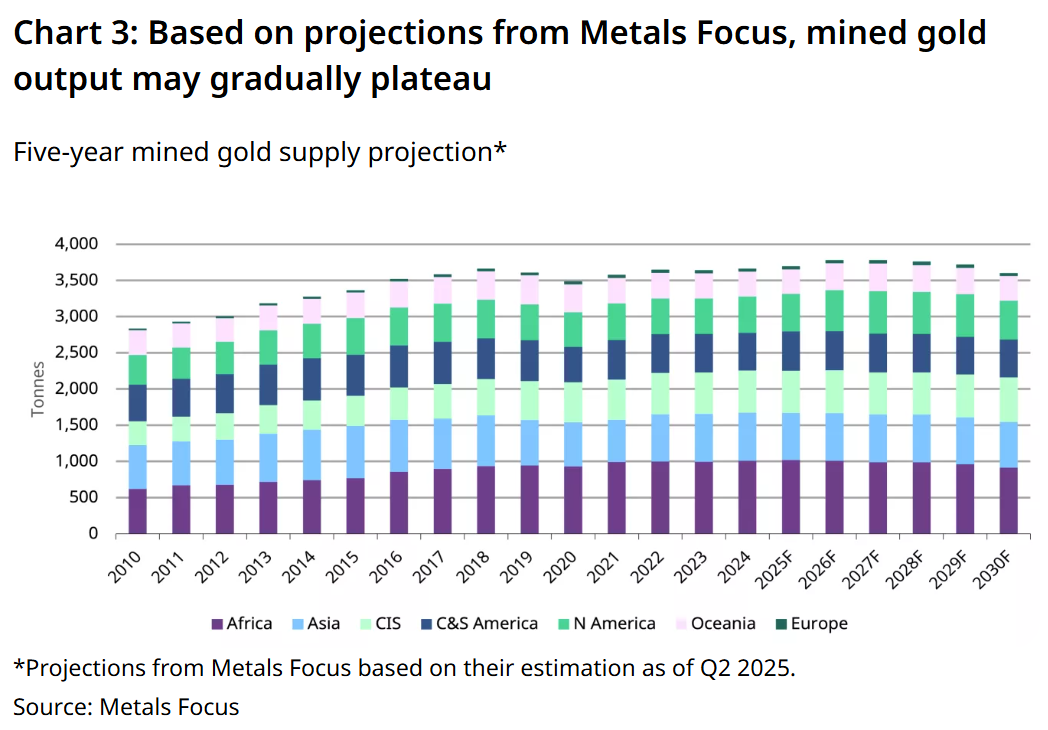
However, their analysis, combined with projections from Metals Focus, indicates that rather than peaking sharply and then falling off, global mined gold production will likely gradually plateau over the next few years. “While new projects and ramp-ups should provide continued support, declining reserves, disruptions and gold miners’ CAPEX costs may limit the upside potential of gold production,” the authors said.
In order to address the question of why mine production hasn’t caught up with gold’s price surge, Reade and Jia analyze the stability of global gold output over recent years. “Mined gold production was virtually unchanged in 2023 and 2024; and volatility in production volumes over the past decade only amounts to 2.3%, or 2.7% in the past 15 years and 3% in the past 20 years,” they noted.
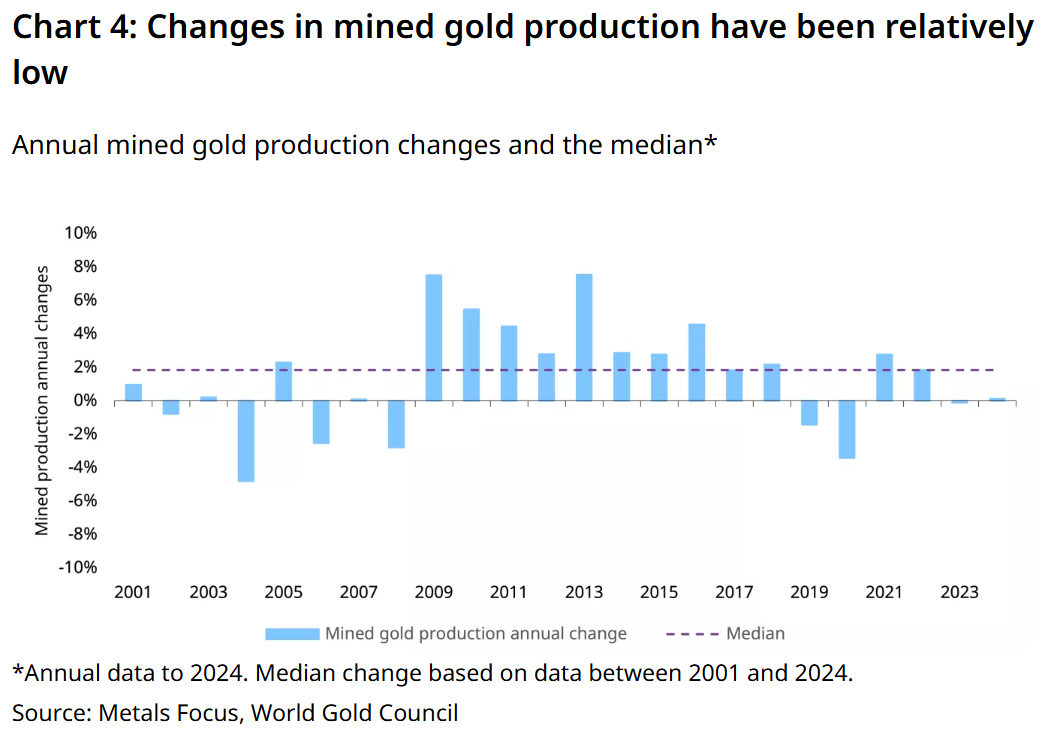
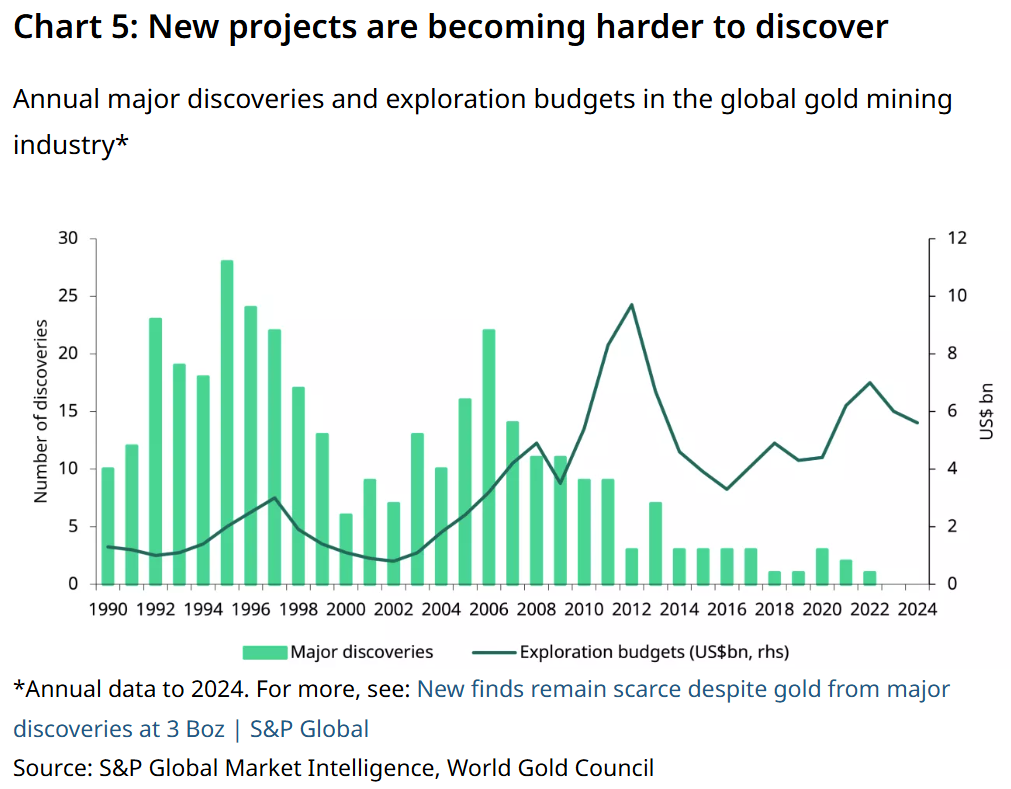
The authors list several reasons why this is the case. “First, gold is mined on every continent except Antarctica, and such geographical dispersion brings stability to global mined gold production even in the face of various disruptions,” they wrote. “Second, the length of the mining process means that it is not easy for miners to increase or decrease production in the short-term. It is also becoming more difficult to find, gain permits for and construct new mines with major discoveries steadily declining (Chart 5), making any substantial increases challenging.”
“It is also important to note that existing mines will age and phase out gradually,” they added. “And absent margin motivations, it is possible that gold production could fall in the medium to longer term, and declining older mines could partially offset any new increase.”
On the other hand, a rising gold price, which usually pushes up miners’ margins, is likely to “Encourage the opening of new mines; See old mines, which were once closed due to lack of profitability, re-open, or maintain existing mines beyond their anticipated life; and Incentivise growth in ASGM.”
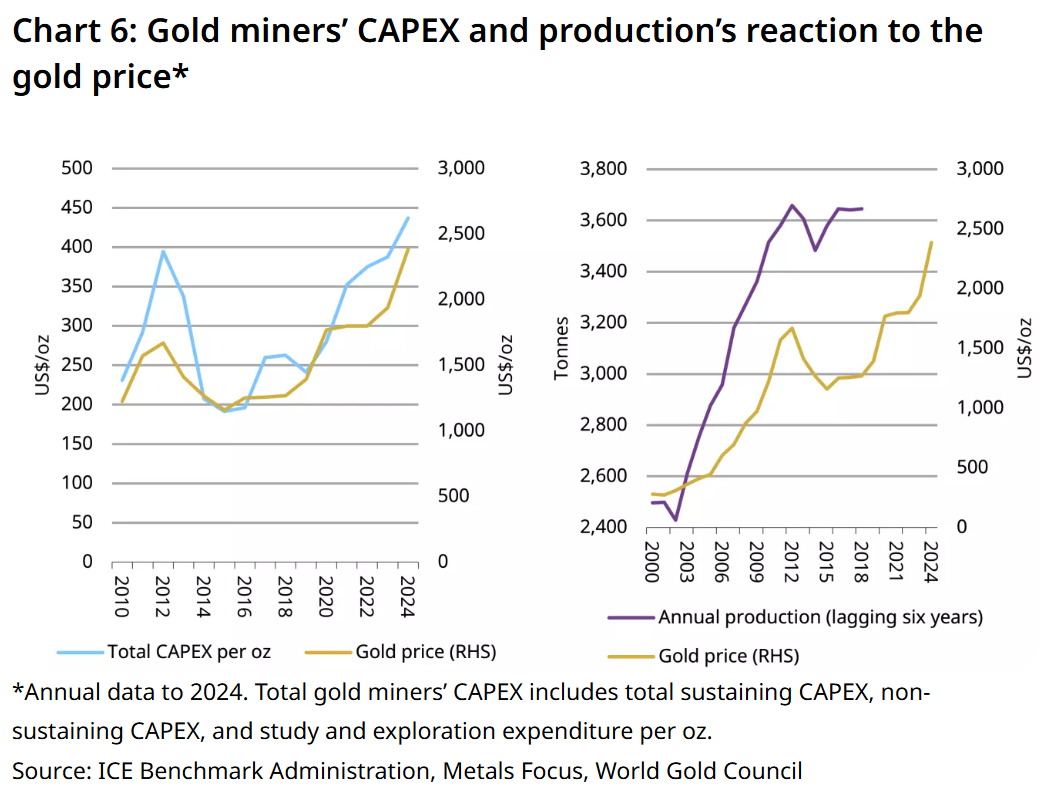
“While re-opening old mines and growth in ASGM may have an immediate impact on gold production, it takes much longer and becomes more difficult for new mines to start producing,” Reade and Jia said. “We found that while a rising gold price usually coincides with higher gold miners’ CAPEX in the same year, mined production lags the gold price by at least six years.”
All of these factors contribute to a scenario where global mined gold production eases up to peak levels in the coming years before plateauing and undergoing a very gradual decline from 2028 onward.
“Alongside relatively stable gold demand – due principally to gold’s dual nature as a consumer good and an investment asset – the global gold market is one of resilience and balance,” they concluded.
Read the full article here: Gold mining output to peak in 2027 with gradual plateau rather than sharp drop – World Gold Council | Kitco News